
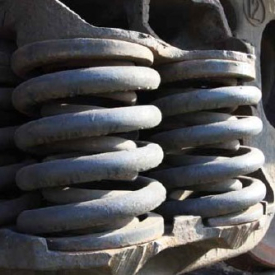
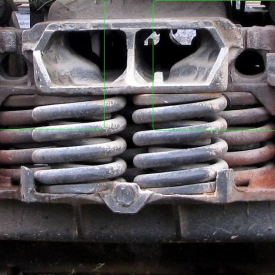
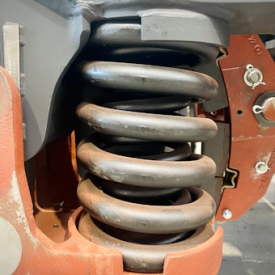
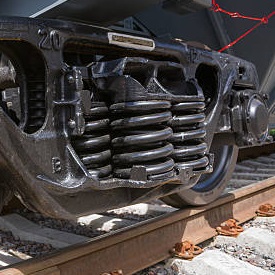
Railway Bogie Compression Spring manufacturing capacity :
Wire Dia. : upto 65 mm.
Outer Dia. : upto 500 mm.
Free Height : upto 1000 mm.
Total Coils : As per user’s requirement.
Load capacity : upto 40 Tons. (per pc.)
What is a Railway Bogie Compression Spring :
Railway Bogie Compression Spring is a critical components utilized within the Bogie assembly of trains. These are specialized Spring designed to absorb shock and support the weight of the rail vehicle, thereby enhancing the overall stability and comfort during transit. Typically constructed from high-strength steel, these springs are engineered to endure substantial loads and environmental stresses associated with railway operations.
The physical characteristics of Railway Bogie Compression Spring includes their coiled shape, which allows them to compress and expand as needed. They are usually cylindrical in design and may be fabricated in various sizes and specifications to accommodate different types of rail cars. Compression Spring here operates on the principle of Hooke’s Law, meaning that the force exerted by the spring is proportional to its compression, an important feature for maintaining dynamic equilibrium in the Rail vehicle.
In terms of composition, Railway Bogie Compression Spring often made from materials such as carbon steel or alloy steel, chosen for their high yield strength and fatigue resistance. The manufacturing process involves precision forging or coiling, followed by processes such as heat treatment and shot peening to enhance their durability and performance. This attention to design and material ensures that Railway Bogie Compression Spring operates reliably over extended periods, crucial for long-haul Rail journeys.
The role of these Springs in the Bogie assembly is significant; they not only act as shock absorbers but also contribute to the overall dynamics of the Railway vehicle during operation. By cushioning the Railway car against irregularities of the track and dampening vibrations, they play an essential role in ensuring passenger comfort and protecting the mechanical integrity of the train. Consequently, understanding the definition, composition, and function of Railway Bogie Compression Spring is paramount for appreciating their impact on Railway vehicle dynamics.
Railway Bogie Compression Spring design :
When it comes to the design of Railway Bogie Compression Spring, several key factors must be taken into account to ensure optimal performance and longevity. One of the primary elements is the selection of materials. The choice of materials profoundly affects the Spring’s performance characteristics, including its strength, fatigue resistance, and elasticity. Common materials used in Spring manufacturing include high-carbon steel and stainless steel, both known for their resilience and ability to endure the harsh conditions typically experienced in railway applications.
Another crucial aspect is the Spring rate, which defines the stiffness of the Railway Bogie Compression Spring. This parameter is instrumental in determining how much load the Spring can bear before it deforms. The Spring rate is tailored to meet the specific operational requirements of the Railway Bogie, ensuring that the system can absorb shocks and maintain stability under varying load conditions. Adjusting this rate is essential for balancing flexibility and rigidity, which can directly influence ride quality and safety.
Dimensions also play a vital role in the design of Railway Bogie Compression Spring. The diameter, height, and wire thickness must be carefully calculated to achieve the desired mechanical properties while adhering to the constraints of the Railway chassis design. Additionally, operational constraints such as temperature fluctuations, humidity and potential exposure to corrosive elements must be assessed to select suitable coatings or treatments that enhance the Springs’ durability.
Ultimately, the design of Railway Bogie Compression Spring is a complex interplay of strength, flexibility, and durability. Designers must ensure that these components not only meet performance requirements but also contribute to the overall efficiency and safety of the railway system.
Railway Bogie Compression Spring function :
Railway Bogie Compression Spring plays a crucial role in Railway systems, significantly impacting the performance and efficiency of Railway Bogies. These Springs are essential components designed to absorb shock, distribute weight, and maintain stability within train vehicles. By understanding the functionality of these Springs, we can appreciate their importance in enhancing both safety and passenger comfort during travel.
One of the primary functions of Railway Bogie Compression Spring is shock absorption. As trains move along the tracks, they encounter various irregularities in the Rail surface that can cause jarring motions. Compression Springs mitigate these shocks, smoothing out the experience for passengers and preventing potential damage to the railcar structure. This shock-absorbing feature is critical, as it helps maintain a safe and stable ride, reducing the risk of derailments or structural failures.
Additionally, Railway Bogie Compression Spring plays an integral role in weight distribution. When a train is fully loaded with passengers and cargo, the need for optimal weight management becomes apparent. Railway Bogie Compression Spring helps balance the load across the vehicle, ensuring that weight is evenly distributed between the wheels. This balance is essential in preventing undue stress on any single wheel or axle, thereby prolonging the lifespan of the railway components.
Moreover, the stability maintenance provided by Railway Bogie Compression Spring is vital for the overall performance of Railway systems. A stable railcar minimizes swaying and vibrations, thus enhancing the comfort of passengers. By ensuring that the train remains level and provides a smooth ride, these springs enhance the travel experience while also upholding the operational efficiency of the Railway system.
In conclusion, the functions of Railway Bogie Compression Spring in railway bogies, including shock absorption, weight distribution, and stability maintenance, are fundamental to ensuring passenger comfort and safety. Their design and implementation directly contribute to the smooth and efficient operation of rail transport systems.
Railway Bogie Compression Spring necessity :
In Railway systems, Railway Bogie Compression Spring plays a vital role within Bogies, which are essentially frameworks that support the weight of train carriages and facilitate smooth movement along the tracks. These Springs are crucial for maintaining the stability and integrity of the system, ensuring both optimal performance and safety as trains navigate various terrains and track conditions.
One of the primary functions of Railway Bogie Compression Spring in bogies is their ability to absorb shocks and vibrations during travel. As trains operate at high speeds, they encounter various forces, such as bumps and irregularities in the track. Compression Spring help to mitigate these forces by compressing and then returning to their original shape, which greatly aids in improving ride quality for passengers. This absorption capability not only enhances comfort but also reduces fatigue on the rail components, prolonging their lifespan and lessening the frequency of maintenance required.
Additionally, the use of Railway Bogie Compression Spring is integral in preventing derailment. Their design allows for the management of lateral forces that may arise during sharp turns or when the train encounters obstacles. By effectively controlling these forces, the Springs ensure that the wheels remain in contact with the Rails, significantly decreasing the risk of accidents. Furthermore, Compression Springs contribute to the overall balance of the train, distributing weight evenly across the bogies and thus enhancing overall safety.
Railway Compression Spring manufacturing process :
The manufacturing process of Railway Bogie Compression Spring involves a series of systematic steps that ensure the final product meets the rigorous demands of Railway applications. The initial phase is material selection, where high-grade steel alloys are commonly chosen for their strength and fatigue resistance. The specifications of these materials often align with relevant industrial standards, such as ASTM A313 or SAE J1112, which ensure that the springs can withstand the mechanical stresses they encounter.
Following material selection, the next stage involves fabrication, where wire of the selected alloy is coiled into the desired shape using advanced coiling machines. These machines are capable of producing springs with precise dimensions and variable designs tailored to specific Bogie configurations. Once coiling is completed, the Springs undergo a process known as “shot peening” which enhances their surface properties, significantly improving fatigue resistance.
The subsequent phase of the manufacturing process is heat treatment. This critical step involves heating the Springs to a designated temperature and gradually cooling them to relieve stresses induced during coiling. Heat treatment enhances the mechanical properties of the Railway Bogie Compression Spring, ensuring they can perform efficiently under load. Depending on the specifications, processes such as tempering or hardening may be applied to further refine their strength and elasticity.
Finishing touches are then added, which may include surface treatments such as coating or plating to improve corrosion resistance and longevity. Quality assurance within the manufacturing process is paramount. Testing methods such as tensile tests, fatigue tests, and dimensional inspections ensure compliance with quality standards and performance specifications, ultimately guaranteeing that the Railway Bogie Compression Spring meet industry expectations for safety and reliability.
Railway Bogie Compression Spring uses :
Railway Bogie Compression Spring plays a crucial role in the overall functionality and efficiency of both passenger and freight trains. These Springs are primarily responsible for supporting the weight of train cars, thereby ensuring stability and safety during operation. Their design allows them to absorb shocks and vibrations caused by track irregularities, which is essential for maintaining the comfort of passengers and the integrity of freight cargo.
In passenger trains, Railway Bogie Compression Spring contribute significantly to ride quality. They are installed in the suspension systems, where they work in tandem with other components to dampen oscillations and reduce the impact of sudden movements. This results in a smoother ride experience for passengers, which is often a key factor in the overall satisfaction of rail travel. Moreover, different train models may employ varying spring specifications based on weight distribution, speed, and intended use, showcasing the versatility of these Springs.
Freight trains also utilize Railway Bogie Compression Spring, albeit with some variations tailored to the specific requirements of cargo transport. For heavy loads, such as bulk materials or machinery, Springs need to be designed to withstand significant pressure while still allowing for adequate suspension mobility. This ensures that the cargo remains stable and secure throughout transit, minimizing the risk of damage.
Additionally, Railway Bogie Compression Spring is vital in heavy-haul trains, which are designed to transport large volumes of goods across long distances. In such applications, the Spring must be manufactured from robust materials to handle extreme forces and fatigue over prolonged periods. The customization and scalability of these springs further highlight their importance in modern rail systems.
Railway Bogie Compression Spring application :
Railway Bogie Compression Spring plays a critical role in various sectors beyond the Railway industry. Their versatile design enables them to absorb and store energy, making them integral to many applications within public transport systems, aviation, and industrial machinery.
One of the notable applications of Railway Bogie Compression Spring can be found in the automotive sector. Vehicles rely on suspension systems where these Springs contribute to shock absorption, ensuring smooth rides. In this context, compression springs not only enhance comfort but also improve vehicle handling by maintaining tire contact with the road surface. This application showcases the spring’s ability to endure repetitive loads over extended periods, similar to their function in Railway Bogies.
Aviation is another field where Railway Bogie Compression Spring is invaluable. Aircraft landing gear systems utilize these Springs to absorb the high-impact forces experienced during landing. Moreover, they are incorporated into various mechanical systems within aircraft, from controlling flaps to actuating doors. Their reliability in extreme conditions, such as variable temperatures and pressures at high altitudes, highlights their versatility.
In industrial machinery, Railway Bogie Compression Spring is employed in numerous settings, including manufacturing equipment and automation systems. They support components like hoppers, conveyor systems, and power tools, providing the necessary pressure and support to operate efficiently. Furthermore, customization is common in these applications, with Springs tailored to different load requirements, sizes, and material specifications designed to withstand harsh environments.
These examples illustrate that the utility of Railway Bogie Compression Spring extends far beyond Railway systems, proving essential across a broad range of transport sectors and industrial environments. Their adaptability to different applications ensures they remain a vital component in modern engineering solutions, reinforcing their critical role in ensuring safety, efficiency, and performance across various industries.