
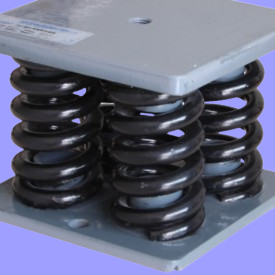
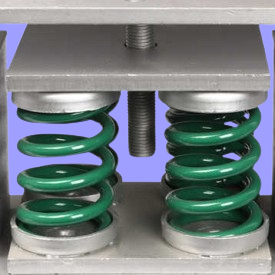
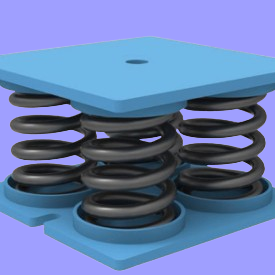
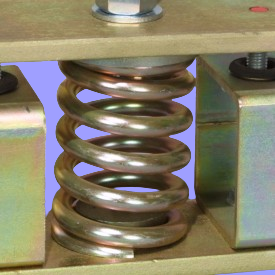
Vibration Isolator Compression Spring manufacturing capacity :
- Wire Dia. : upto 65 mm.
- Outer Dia. : upto 500 mm.
- Free Height : upto 1000 mm.
- Total Coils : As per user’s requirement.
- Load capacity : upto 40 Tons. (per pc.)
Introduction to Vibration Isolator Compression Spring :
Vibration Isolator Compression Spring is specialized mechanical components designed to absorb and mitigate vibrations in various engineering and manufacturing applications. These Springs are engineered to compress and expand in response to dynamic loads, effectively reducing the transfer of vibration energy. Their unique design allows them to maintain structural integrity while providing essential support in machinery, automotive, aerospace, and numerous industrial settings.
The concept of Vibration Isolation dates back to the early 20th century, as engineers sought effective solutions to combat the damaging effects of vibration on machinery and structural components. Early methods involved rudimentary cushions and padding; however, the introduction of Coil Springs marked a significant advancement. Vibration Isolator Compression Spring emerged as a result of continuous innovations in material science and engineering techniques.
These Vibration Isolator Compression Springs are typically made from high-tensile materials such as steel or specialized alloys, which afford them enhanced durability and flexibility. Their design caters specifically to the frequency and amplitude of vibrations experienced in their operating environments. This allows engineers to tailor Spring characteristics such as stiffness, damping, and effective load capacity to fit precise application needs.
Vibration Isolator Compression Spring plays a vital role in improving the longevity and performance of machinery. By minimizing resonance effects and neglecting the transmission of vibrations, these Springs contribute significantly to operational efficiency. Their application can be witnessed across various sectors, where they ensure reduced wear and tear on components while fostering safer, more reliable operation. Understanding the fundamental principles and historical context of Vibration Isolator Compression Spring is crucial for those engaged in engineering and design disciplines.
The function of Vibration Isolator Compression Spring :
Vibration Isolator Compression Spring serve a critical role in various engineering and industrial applications. These Springs are designed specifically to absorb and dissipate energy generated by vibrations and impacts, thereby protecting sensitive components and structures from potential damage. Their fundamental function revolves around the principles of elasticity and compression, enabling them to respond effectively to dynamic loads.
When a force or vibration is applied, a Vibration Isolator Compression Spring undergoes a process of compression. This compression generates a counteracting force that opposes the incoming energy. As the Spring compresses, it stores potential energy and then releases it as the force subsides, effectively reducing the amplitude of the vibration. This mechanism is particularly beneficial in applications such as automotive engineering, manufacturing machinery and electronic devices where maintaining operational integrity is paramount.
Furthermore, the design and material of Vibration Isolator Compression Spring plays an essential role in their effectiveness. Typically crafted from high-grade steel or similar alloys, these Springs exhibit superior fatigue resistance and longevity. Their geometric configuration and Spring constant are also critical factors; the dimensions and coil density influence the Spring’s rigidity and rebound characteristics. Therefore, selecting the appropriate Spring based on the specific application requirements is vital for optimal performance.
In aggregate, Vibration Isolator Compression Spring acts as a buffer against detrimental vibrations, enhancing the reliability and lifespan of equipment. By mitigating the impact of vibrations, they not only protect sensitive components but also contribute to overall system stability. Understanding the operational dynamics of these Springs is crucial for engineers and designers to implement effective solutions in their respective fields.
Importance of Vibration Isolator Compression Spring :
Vibration Isolator Compression Spring plays a crucial role in a variety of industries by mitigating the adverse effects of vibrations on equipment and operations. Machines, vehicles, and other mechanical systems often experience frequent vibrations due to their operation, which can lead to equipment degradation, malfunction, and even catastrophic failures if not properly managed. These vibrations can arise from many sources, including engine operation, rotating machinery, and even external forces such as traffic or seismic activities.
One of the primary reasons for utilizing these Springs is to enhance the longevity and reliability of equipment. Continuous exposure to severe vibrations can result in misalignment of components, increased wear and tear, and eventual breakdown, leading to increased maintenance costs and operational downtime. By implementing Vibration Isolator Compression Spring, firms can significantly reduce the amplitude of vibrations transmitted through equipment, ensuring that machinery operates smoothly and efficiently.
The necessity of Vibration Isolator Compression Spring stems from their ability to protect both equipment and personnel from the potentially detrimental effects of vibrations. By addressing vibrations proactively, industries can ensure operational efficiency, enhance safety, and reduce long-term costs related to equipment maintenance and replacement.
Applications of Vibration Isolator Compression Spring :
Vibration Isolator Compression Springs are utilized across various industries to mitigate the effects of vibration and shock in mechanical systems. One notable application can be found in the automotive sector, where these Springs are used in suspension systems. By absorbing shocks from road irregularities, they enhance ride quality and ensure greater safety for vehicle occupants. In this context, Vibration Isolator Compression Springs play a critical role in maintaining the stability of the vehicle, reducing wear on other components and improving overall performance.
The manufacturing sector also benefits significantly from the integration of Vibration Isolator Compression Spring. In machine tools, for example, these Springs are employed to reduce vibrations during the machining process. This application not only improves the accuracy of the machining but also prolongs the lifespan of the machinery by minimizing wear and tear caused by excessive vibrations. Additionally, they can be found in assembly lines, helping to stabilize equipment that experiences continuous movement and force.
Furthermore, in the realm of consumer electronics, Vibration Isolator Compression Springs are often integrated into devices like printers and scanners. Here, they help in damping the vibrations produced during mechanical movement, improving the precision and reducing the noise output of these devices. In summary, the versatility of Vibration Isolator Compression Springs spans diverse industries, proving essential for enhancing performance, safety, and longevity in multiple applications.
Installation and maintenance of Vibration Isolator Compression Spring :
The installation of Vibration Isolator Compression Spring is a critical process that requires careful planning and execution to ensure optimal performance and longevity. First and foremost, gather the necessary tools and materials. Common tools for installation include a torque wrench, pliers, and an adjustable wrench. Depending on the system, you may also require a spring compressor for safe handling and installation of the Springs. Prior to installation, confirm that the working environment is clean and free from contaminants that could affect spring performance.
Begin by inspecting the Vibration Isolator Compression Springs for any signs of damage or irregularities. If any defects are observed, it is advisable to replace the Springs before installation. Once the springs are confirmed to be in good condition, follow the manufacturer’s installation guidelines closely. Typically, Vibration Isolator Compression Springs are placed between the mounting surfaces of the equipment and the base structure, facilitating the optimal distribution of loads and isolating vibrations effectively.
After installation, it is vital to regularly maintain the Vibration Isolator Compression Spring to ensure their effectiveness. Required maintenance generally includes periodic inspections to check for wear and tear, ensuring that there is no rust or corrosion on the Spring and confirming that the operating environment remains within specified limits. Regularly lubricating the Springs can prevent rust and enhance flexibility, thereby contributing to smoother operation. Additionally, maintaining proper tension is key; periodic adjustments may be necessary should the Springs compress over time.